
A linear stapler and a linear cutter stapler both create straight staple lines, but they perform different surgical tasks. A linear stapler closes or seals tissue without cutting it, while a linear cutter stapler divides tissue and applies staple lines during the same firing sequence. The correct choice therefore depends first on whether the tissue must only be closed or must also be transected.
A linear stapler is a surgical stapling device that places straight rows of staples without an integrated cutting function, whereas a linear cutter stapler combines tissue cutting and stapling in one instrument.
This functional distinction affects device configuration, staple-line length, application planning and cartridge selection. Product selection and use should always follow the applicable instructions for use, approved indications and institutional protocols.
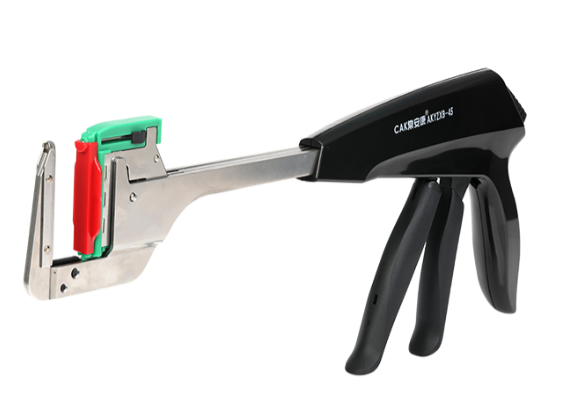
A surgical linear stapler is designed to approximate and close tissue in a straight line without cutting through the tissue. It is suitable when the tissue is already positioned for closure or when any required tissue division is performed separately.
The absence of an integrated knife is the most important identifying feature. Once the jaws are positioned and the device is fired, the stapler forms a linear closure while leaving the tissue between or beyond the staple line undivided.
CAK Medical offers disposable linear stapler models with three suture lengths:
AKYZXB-45H/L: 44 mm suture length
AKYZXB-60H/L: 60 mm suture length
AKYZXB-90H/L: 92 mm suture length
The three models use 19, 25 and 39 staples respectively. Available configurations are listed with 1.5 mm or 2.0 mm suture thicknesses, 3.8 mm or 4.5 mm staple heights, and blue or green cartridges. Corresponding cartridge models include AKYZXBD-45H/L, AKYZXBD-60H/L and AKYZXBD-90H/L. Because this product does not cut tissue, it should not be treated as an interchangeable substitute for a linear cutter. Its role is primarily defined by the need for linear tissue closure.
A linear cutter stapler places parallel staple lines while an integrated cutting mechanism divides the tissue between them. This combined action is useful when a procedure requires resection, transection or separation together with closure of the tissue margins.
CAK Medical describes its disposable cutter stapler for applications that may include intestinal surgery, gastric bypass procedures, rectal surgery and thoracic surgery. The precise indication for a selected model must still be confirmed against its product labeling and instructions for use.
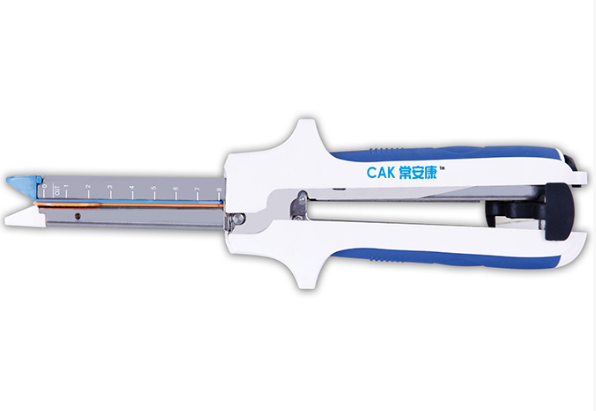
CAK offers AKYQGA and AKYQGB linear cutter stapler series in nominal 55, 60, 75, 80 and 100 configurations.
| Model | Cutting Length | Suture Length | No. of Staples |
| AKYQGA-55L/H | 55 mm | 57 mm | 56 |
| AKYQGA-60L/H | 62 mm | 64 mm | 64 |
| AKYQGA-75L/H | 75 mm | 77 mm | 76 |
| AKYQGA-80L/H | 82 mm | 84 mm | 84 |
| AKYQGA-100L/H | 102 mm | 104 mm | 104 |
| Model | Cutting Length | Suture Length | No. of Staples |
| AKYQGB-55L/H | 51 mm | 55 mm | 56 |
| AKYQGB-60L/H | 56 mm | 60 mm | 60 |
| AKYQGB-75L/H | 71 mm | 75 mm | 76 |
| AKYQGB-80L/H | 76 mm | 80 mm | 80 |
| AKYQGB-100L/H | 96 mm | 100 mm | 100 |
Both product series are listed with 1.5 mm or 2.0 mm suture thicknesses, 3.8 mm or 4.5 mm staple heights, and blue or green cartridge options. Matching reload model numbers are available for each instrument length.
The following comparison summarizes the main differences.
| Comparison Point | Linear Stapler | Linear Cutter Stapler |
| Primary function | Stapling and tissue closure | Simultaneous cutting and stapling |
| Integrated cutting knife | No | Yes |
| Tissue after firing | Closed but not divided by the device | Divided between the staple lines |
| CAK suture lengths | 44, 60 and 92 mm | 55–104 mm, depending on series and model |
| CAK cutting lengths | Not applicable | 51–102 mm |
| Listed suture thicknesses | 1.5 or 2.0 mm | 1.5 or 2.0 mm |
| Listed staple heights | 3.8 or 4.5 mm | 3.8 or 4.5 mm |
| Cartridge colors | Blue or green | Blue or green |
| Main selection question | Does the tissue only need closure? | Must the tissue be divided and stapled together? |
| Typical device category | Open surgical stapler | Open surgical cutting and stapling device |
The table should not be interpreted as a universal guide for cartridge colors or tissue thickness. Cartridge colors, open staple heights, closed staple heights and intended tissues may vary by manufacturer and product series.
The U.S. Food and Drug Administration recommends selecting an appropriate staple size for the tissue type and thickness and following the manufacturer’s labeling. It also identifies cartridge color, staple height, intended tissue and cartridge size as important labeling information for surgical staplers.
This is the first and most decisive question. Choose a linear stapler when the required action is straight-line closure without cutting. Choose a linear cutter stapler when the procedural plan requires the instrument to divide tissue while forming staple lines.
Selecting a cutting stapler for a closure-only task can introduce an unnecessary transection function. Conversely, selecting a non-cutting linear stapler for a planned transection means that tissue division must be completed with a separate instrument and technique.
The device must cover the intended tissue width without extending unnecessarily into surrounding structures. CAK linear stapler options provide suture lengths of 44, 60 and 92 mm. The linear cutter stapler range is broader, with listed suture lengths from 55 to 104 mm and cutting lengths from 51 to 102 mm, depending on the selected AKYQGA or AKYQGB model.
The model name alone should not be used as the cutting measurement. For example, the AKYQGA-100L/H is listed with a 102 mm cutting length and a 104 mm suture length, while the AKYQGB-100L/H has a 96 mm cutting length and a 100 mm suture length.
The tissue must be evaluated before the device is closed and fired. A cartridge intended for one tissue range should not automatically be used for thinner or thicker tissue simply because it fits the instrument.
CAK lists blue and green cartridge configurations with staple heights of 3.8 mm and 4.5 mm. However, the final cartridge choice should be based on the product labeling, the tissue being treated and the applicable clinical protocol—not color alone.
The products compared in this article belong to CAK Medical’s open surgical stapler range. Procedures performed through minimally invasive access may require longer shafts, articulation, compatible reloads and access through an appropriate trocar.
For those applications, the open devices should be compared separately with CAK Medical’s endoscopic staplers. An endoscopic cutter stapler should not be selected solely because it performs cutting and stapling; access diameter, shaft length, articulation and reload compatibility also matter.
Hospitals and distributors should evaluate more than the instrument name. A practical review should include:
Product model and cartridge compatibility
Suture and cutting lengths
Staple count and staple-height options
Intended tissue and approved indications
Packaging and sterilization information
Shelf life and storage conditions
Instructions for loading, positioning and firing
Applicable certificates and regulatory documents
Traceability and lot identification
Sample availability and supply continuity
These points are especially important when comparing more than one disposable surgical stapler within the same product portfolio.
Several problems can arise when devices are compared only by general product names.
First, “linear stapler” and “linear cutter stapler” should not be used interchangeably. Their core mechanical functions are different.
Second, nominal model numbers do not always equal the precise cutting or suture length. Technical tables should be checked before a model is specified.
Third, cartridge color is not a universal tissue-selection system across all manufacturers. The color must be interpreted using the labeling for the exact device and reload.
Fourth, open and endoscopic staplers should not be grouped together without considering the access route. A minimally invasive procedure may require features that are not needed in open surgery.
Finally, a longer staple line is not automatically a better choice. The selected length should correspond to the anatomy, operative plan and approved use of the device.
A linear stapler closes tissue without cutting, while a linear cutter stapler divides tissue and forms staple lines in the same operation. Selection should consider the required function, tissue characteristics, staple-line length, cutting length, cartridge configuration and surgical access route. CAK Medical offers multiple disposable models for open surgical stapling applications. Contact the CAK team to request model specifications, product documentation, samples or a bulk quotation.
A linear stapler applies straight staple lines without cutting the tissue. A linear cutter stapler contains a cutting mechanism that divides the tissue while staple lines are formed. The choice depends on whether the procedure requires closure only or combined transection and closure.
No. The CAK disposable linear stapler is designed for stapling and tissue closure without an integrated cutting function. If tissue division is required, it must be performed separately or with a suitable cutting stapler.
The CAK linear stapler range includes models with suture lengths of 44, 60 and 92 mm. The listed models are AKYZXB-45H/L, AKYZXB-60H/L and AKYZXB-90H/L.
Depending on the selected AKYQGA or AKYQGB model, the listed cutting lengths range from 51 to 102 mm. Available nominal configurations include 55, 60, 75, 80 and 100.
Cartridge selection should not be based on color alone. Buyers and users must confirm cartridge compatibility, staple height, intended tissue range and instructions for use for the exact instrument and reload.
Not automatically. Although both may cut and staple tissue, an endoscopic model has additional requirements related to shaft design, access diameter, articulation and trocar compatibility. The surgical approach and applicable product instructions must guide selection.


 English
 français
 Español
 русский
 Deutsch
 italiano
 português
 العربية
 tiếng việt
 Türkçe

