
Ultrasonic scalpels and electrosurgical instruments can both cut tissue and support hemostasis, but they deliver energy in different ways. An ultrasonic scalpel converts electrical energy into high-frequency mechanical vibration at the blade, while electrosurgery uses high-frequency electrical current to create a tissue effect.
An ultrasonic scalpel is a surgical energy instrument that uses mechanical blade vibration and controlled heat to dissect tissue and form a protein coagulum for hemostasis.
Neither technology is universally superior. The appropriate choice depends on the procedure, tissue type, required cutting speed, vessel-sealing task, proximity to sensitive structures, instrument access, generator compatibility, and the device’s approved instructions for use.
Electrosurgery is a broad category that includes monopolar and bipolar systems. The FDA describes general electrosurgical devices as instruments that cut or remove tissue and control bleeding through high-frequency electrical current. Bipolar vessel sealers apply current between two electrodes positioned close to each other.
An ultrasonic scalpel uses electrical power differently. The generator and handpiece convert electrical energy into mechanical movement at the blade. The vibrating blade interacts with compressed tissue, producing mechanical cutting and heat-related protein denaturation.
The distinction is therefore not simply “hot instrument versus cold instrument.” Both technologies can generate heat, and both can cause unintended tissue effects when they are activated too long, used too close to sensitive structures, or applied outside their intended conditions.
| Comparison Point | Ultrasonic Scalpel | Monopolar Electrosurgery | Bipolar Electrosurgery |
| Primary energy delivered to tissue | Mechanical vibration with heat generation | High-frequency electrical current | High-frequency electrical current between nearby electrodes |
| Common tissue effect | Cutting and coagulation during the same activation | Cutting, dissection, or coagulation depending on waveform and technique | Localized coagulation or vessel sealing; some systems include mechanical cutting |
| Electrical current through the patient | No electrosurgical current path through the patient | Current travels through tissue to a return electrode | Current is concentrated between two electrodes |
| Heat generation | Produced by blade–tissue interaction and protein denaturation | Produced by tissue resistance to electrical current | Produced within tissue held between the electrodes |
| Thermal spread | Device-, tissue-, and activation-dependent | Device-, power-, and activation-dependent | Device-, compression-, and activation-dependent |
| Surgical plume | Can generate aerosol or plume | Generates surgical smoke | Generates surgical smoke or vapor |
| Typical equipment | Generator, handpiece or transducer, shear and activation control | Generator, active electrode and return electrode | Generator and bipolar instrument |
The table describes general technology categories. Actual performance varies between devices, operating modes, and procedures.
Ultrasonic instruments create rapid mechanical movement at the active blade. This movement contributes to tissue separation, while compression and heat denature proteins and help form a coagulum around small vessels.
Cutting performance is influenced by more than generator output. Important variables include:
Tissue thickness and composition
Jaw compression
Blade geometry
Applied tension
Selected energy level
Duration of activation
Whether the blade is used continuously or intermittently
Condition of the tissue pad and working surface
An ultrasonic device can therefore cut quickly in one tissue type but behave differently in another. A single cutting-speed percentage should not be generalized across all tissues and operating conditions.
Electrosurgery uses high-frequency current to produce controlled tissue heating. Changing the waveform, power setting, electrode design, contact area, and application technique changes the resulting tissue effect.
Monopolar instruments are widely used for dissection, cutting, and spot coagulation. Bipolar instruments concentrate current between two electrodes and are commonly selected when the target tissue can be grasped between the jaws. Advanced bipolar vessel sealers may regulate energy delivery according to tissue conditions, but their performance remains specific to the selected platform and instrument.
Electrosurgery may provide flexibility because one generator can support different electrodes and operating modes. However, the selected mode and power setting must match the instrument, procedure, and manufacturer’s instructions.
Thermal spread is the transfer of heat beyond the intended treatment area. It matters when an energy device is used near nerves, ducts, vessels, or other heat-sensitive structures.
Thermal behavior changes with the device, power level, tissue, compression, activation duration, cooling time, and measurement method.
In one controlled ex vivo study using porcine muscle, the highest mean temperatures measured at the instrument tips after five seconds at the tested high settings were 78.9°C for monopolar diathermy, 41.9°C for bipolar diathermy, 47.6°C for an ultrasonic scalpel, and 44.2°C for a bipolar vessel-sealing system. After 15-second activation, the instrument tips remained above 42°C for different periods. These figures describe one experimental setup and should not be treated as specifications for every device.
Practical thermal-control considerations include:
Avoiding unnecessarily long activation
Allowing the jaws or blade to cool between repeated activations
Keeping the active surface away from adjacent tissue
Maintaining direct visualization
Avoiding contact with clips, staples, or other metal objects unless permitted
Following the specified power level and tissue range
Inspecting the blade, jaw, and tissue pad before use
“Lower thermal spread” should therefore be treated as a comparative test result under stated conditions—not as a guarantee that an instrument is safe at any distance.
An ultrasonic scalpel combines tissue grasping, dissection, coagulation, and cutting in one hand instrument. This can reduce instrument exchanges in procedures where the same tissue bite requires both division and hemostasis.
Monopolar electrosurgery may offer rapid cutting and broad dissection through multiple electrode shapes. Bipolar instruments are generally more focused on tissue held between their electrodes, although advanced systems may also incorporate a mechanical cutting blade.
The practical question is not simply which device cuts faster. Procurement and clinical teams should consider:
Whether the tissue must be grasped before division
Whether blunt dissection is required
The size of the operative space
The need for articulation
Shaft diameter and length
Access through a trocar
The frequency of instrument changes
Compatibility with the existing generator
All vessel-sealing claims should be tied to the exact device, vessel range, tissue type, and validation method. A performance claim established for one ultrasonic or bipolar system cannot be transferred to another manufacturer’s product.
CAK states that its ultrasonic scalpel is designed to coagulate vessels up to 5 mm. Because this is a device-specific claim, hospitals and distributors should confirm it against the current IFU, regulatory documentation, and supporting validation report before including it in a clinical protocol or tender specification.
Ultrasonic energy should not be described as “smoke-free.” Research has shown that electrosurgery and ultrasonic dissection can both generate airborne particles or surgical plume. The particle size and composition may differ, but appropriate smoke evacuation and operating-room controls remain relevant for both technologies.
This is an important selection point because a product that creates less visible smoke under one condition may still generate aerosol that is not readily visible.
A device-selection process should start with clinical and technical requirements rather than a single marketing claim. When comparing surgical energy devices, evaluate the complete system.
Clarify whether the main task is:
Rapid tissue cutting
Fine dissection
Spot coagulation
Vessel sealing
Simultaneous cutting and coagulation
Working near a heat-sensitive structure
One instrument may perform several of these tasks, but its approved tissue range and intended use still control selection.
Confirm:
Maximum validated vessel diameter
Tissue thickness range
Required jaw compression
Seal-cycle behavior
Whether a separate mechanical cut is required
Applicable warnings and contraindications
Do not rely only on a general product category such as “ultrasonic” or “advanced bipolar.”
For procedures near nerves, ducts, or other sensitive structures, review:
Lateral thermal spread test method
Maximum blade or jaw temperature
Cooling time after activation
Recommended distance from adjacent structures
Effect of repeated activation
Performance in wet and dry conditions
The test report should state the tissue model, activation time, energy level, and measurement position.
For minimally invasive surgery, consider:
Shaft diameter
Working length
Trocar compatibility
Jaw profile
Rotation
Articulation
Hand or foot activation
Visibility of the active blade
Cable routing and generator placement
An energy platform includes more than the disposable shear. Procurement teams should review:
Generator availability
Handpiece or transducer compatibility
Disposable and reusable components
Torque wrench and test accessories
Foot-switch compatibility
Cleaning and maintenance requirements
Staff training
Consumable availability
Product traceability
Regulatory and quality documents
The CAK ultrasonic surgical scalpel system is listed with an AKG10 generator, AKHP10 handpiece, AKFS10 foot switch, and four curved soft-tissue shear lengths. The handpiece accessories include a torque wrench and test rod.
| Component | CAK Model | Published Description |
| Generator | AKG10 | Ultrasonic generator |
| Handpiece | AKHP10 | Supplied with torque wrench and test rod accessories |
| Soft-tissue shear | AKUS14A | 140 mm shaft length, curved cutter |
| Soft-tissue shear | AKUS23A | 230 mm shaft length, curved cutter |
| Soft-tissue shear | AKUS36A | 360 mm shaft length, curved cutter |
| Soft-tissue shear | AKUS45A | 450 mm shaft length, curved cutter |
| Foot switch | AKFS10 | System activation accessory |
All four listed soft-tissue shear models have a published shaft diameter of 5.5 mm.
The available shaft lengths allow buyers to compare configurations for different access depths. Final selection should also confirm the intended procedure, trocar compatibility, sterile packaging, activation controls, vessel range, and applicable regulatory documentation.
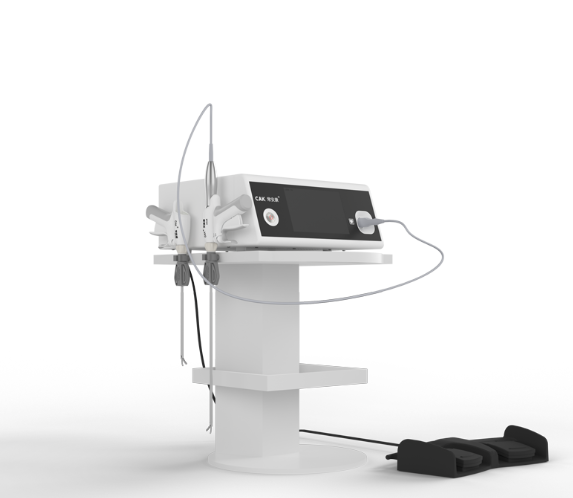
Ultrasonic scalpels use mechanical vibration to cut and coagulate tissue, while electrosurgery uses high-frequency electrical current. Ultrasonic technology may offer controlled dissection and reduced thermal spread compared with conventional monopolar energy under specific test conditions, but no energy device is free from heat or plume. Selection should be based on the procedure, tissue, vessel range, access route, validated performance, generator compatibility, and current IFU.
U.S. Food and Drug Administration. Premarket Notification (510(k)) Submissions for Electrosurgical Devices for General Surgery.
SAGES-related systematic review. Ultrasonic and Nonultrasonic Instrumentation: A Systematic Review and Meta-analysis. JAMA Surgery.


 English
 français
 Español
 русский
 Deutsch
 italiano
 português
 العربية
 tiếng việt
 Türkçe

