
Surgical wound closure does not end when staples are applied. The period after closure, including incision observation, wound management, and staple removal, is also an important part of the overall care process. Understanding disposable skin stapler use helps healthcare providers evaluate not only the closure device itself but also the complete workflow surrounding postoperative management.
A medical skin stapler is designed for external skin closure after surgical procedures, helping approximate wound edges through a series of formed staples. However, successful wound management depends on more than the stapling device. Proper follow-up, suitable removal tools, and consistent staple performance all contribute to a complete closure solution.
For hospitals, surgical centers, and medical distributors, evaluating skin stapling products requires attention to both device performance and the supporting workflow after application.
Disposable skin stapler use is commonly associated with external surgical incision closure, where healthcare providers need a practical method for bringing skin edges together after a procedure.
A medical skin stapler is generally used in situations involving:
Surgical incision closure
Skin approximation
Postoperative wound management
Compared with internal stapling devices designed for tissue connection, skin staplers focus on external closure. Their design is intended for placing staples across the skin surface, creating a visible staple line that can later be monitored and removed according to clinical requirements.
The role of a disposable skin stapler is not limited to the moment of closure. Because the staple line remains during the healing period, factors such as staple consistency, product reliability, and compatibility with removal tools become important considerations.
For healthcare organizations purchasing medical devices, a complete evaluation should consider the entire process from initial closure to follow-up care.
After a medical skin stapler creates a staple line, postoperative management becomes an important part of the wound care process. Healthcare providers typically monitor the incision area to evaluate healing progress and identify any conditions that may require attention.
Important aspects of follow-up management include:
Wound observation
Staple-line inspection
Dressing management
Monitoring changes around the incision area
Scheduled clinical follow-up
The purpose of observation is to ensure that the incision continues to progress appropriately during the healing period. The staple line provides a visible reference point, allowing healthcare professionals to assess the condition of the wound.
For medical facilities, selecting a reliable skin stapling system means considering not only the initial closure process but also how the device supports routine postoperative workflows.
This is why disposable skin stapler use should be viewed as part of a broader wound management process rather than as an isolated procedure.
Skin stapling involves two connected stages: staple placement and staple removal. While much attention is usually given to the stapler itself, the removal process is also an important part of the closure system.
A complete skin stapling solution should consider the compatibility between the stapler and the removal device. Using an appropriate remover helps healthcare providers manage the removal stage according to clinical requirements.
CAK Medical provides skin stapler products together with the CAKCDQ-118 Staple Remover, supporting a more complete workflow from closure to follow-up.
The importance of a dedicated remover includes:
Supporting controlled staple removal
Matching the design of skin staples
Improving workflow consistency
Reducing dependence on unsuitable tools
For hospitals and distributors, evaluating the complete product system can simplify supply management and ensure that both closure and removal requirements are considered.
The design of a medical skin stapler directly influences how staples are formed and how the device performs during skin closure. Staple geometry, including diameter and formed dimensions, is an important specification when comparing different products.
CAK Medical skin stapler configurations include:
| Model | Staple Diameter | Before Forming | After Forming | Number of Staples |
|---|---|---|---|---|
| AKYPF-35A | 0.6 mm | 12.7 × 3.5 mm | 7.0 × 4.2 mm | 35 |
| AKYPF-35B | 0.5 mm | 10.8 × 2.8 mm | 6.0 × 3.8 mm | 35 |
These specifications demonstrate that different staple configurations exist to support different closure requirements.
When evaluating skin stapler design, buyers should consider the relationship between:
Staple geometry → Tissue approximation → Closure characteristics
The staple diameter and formed dimensions influence the final staple structure. Therefore, product specifications should be reviewed together rather than focusing on a single parameter.
For medical procurement teams, detailed specification information helps compare products from different suppliers and identify solutions suitable for different clinical environments.
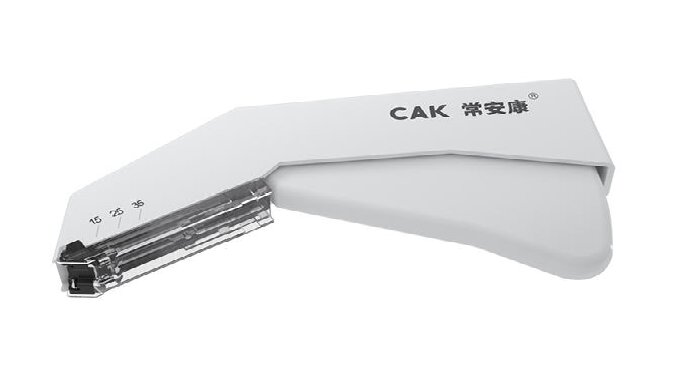
Choosing among different skin stapler manufacturers requires evaluating more than product appearance or basic specifications. For medical device buyers, manufacturing consistency and quality control are critical factors.
Important considerations include:
Consistency of staple formation
A reliable manufacturer should maintain stable production standards to ensure consistent device performance.
Sterile packaging
Disposable medical devices require appropriate packaging processes to maintain product integrity before use.
Device traceability
Clear product identification and documentation support quality management throughout the supply chain.
Material control
The selection and control of materials influence product reliability and manufacturing consistency.
Dimensional consistency
Accurate manufacturing processes help maintain consistent staple geometry and device performance.
Quality management
Established quality systems are essential for medical device production.
Manufacturers such as CAK Medical provide disposable skin staplers in multiple configurations and also offer compatible staple-removal devices, supporting different requirements from healthcare providers and distributors.
The value of a medical skin stapler extends beyond the moment of incision closure. A complete skin closure workflow includes device selection, staple performance, postoperative observation, and appropriate removal.
Understanding disposable skin stapler use helps hospitals and medical distributors evaluate products from a broader perspective, considering both closure requirements and follow-up needs.
From closure to removal, each stage depends on reliable device design and consistent product quality. CAK Medical provides disposable skin stapler solutions with different configurations to support healthcare applications requiring dependable external wound closure systems.
Patients should follow healthcare provider instructions regarding wound care, keeping the area clean and monitoring any changes that may require medical evaluation.
The timing of staple removal depends on factors such as the location of the incision, healing progress, and clinical assessment by healthcare professionals.
A dedicated staple remover is generally designed specifically for controlled removal. Healthcare providers should use appropriate tools according to clinical requirements.
Changes such as increasing discomfort, unusual discharge, significant swelling, or other concerns should be evaluated by a healthcare professional.
No. Different skin staplers may have different staple diameters, dimensions, and formed shapes depending on manufacturer design.
Disposable skin staplers are designed for single-use applications to support sterility requirements and consistent device performance.


 English
 français
 Español
 русский
 Deutsch
 italiano
 português
 العربية
 tiếng việt
 Türkçe

