
Before a surgical stapler is used in a clinical environment, it must pass a series of quality evaluations to confirm that its design, materials, mechanical performance, and packaging meet the expected requirements. Unlike ordinary instruments, surgical staplers rely on precise mechanical movement and controlled staple formation, which means even small variations in components may affect device performance.
Different stapler designs also require different quality considerations. A medical skin stapler, surgical linear stapler, and circular stapler serve different functions, but all require strict control throughout the manufacturing process.
For hospitals, distributors, and medical device buyers, understanding how surgical staplers are tested provides a clearer view of what makes a reliable medical device and why manufacturing quality systems are essential.
Surgical staplers are precision medical devices designed to create consistent tissue closure. Their performance depends on multiple factors, including component accuracy, mechanical reliability, and staple formation quality.
Although different stapler types have different applications, the basic quality process follows a similar principle: ensuring that the final device performs according to its intended design.
| Surgical Stapler Type | Main Quality Focus | Typical Verification Areas |
|---|---|---|
| Medical Skin Stapler | External skin closure consistency | Staple formation, firing performance, dimensional accuracy |
| Surgical Linear Stapler | Linear staple-line reliability | Staple height, staple-line length, alignment |
| Circular Stapler | Circular closure consistency | Diameter accuracy, staple ring formation, mechanical performance |
A medical skin stapler requires reliable staple deployment for external wound closure, while a surgical linear stapler requires consistent straight staple-line formation. In comparison, circular staplers require precise circular closure performance.
Because of these differences, manufacturers must establish product-specific testing methods instead of applying a single quality standard to every device type.
Professional skin stapler manufacturers focus on controlling every stage of production to maintain consistent device performance. Manufacturing quality is not only determined by the final inspection but also by how materials, components, and assembly processes are managed.
One important area is dimensional inspection. Manufacturers check whether components match design specifications, including staple diameter, staple dimensions, and device structure. Consistent dimensions help ensure that each device functions according to its intended design.
Material inspection is another essential step. Medical staplers require carefully controlled materials to support mechanical performance and product stability. Manufacturers evaluate material specifications, compatibility between components, and characteristics that may influence device reliability.
Assembly inspection focuses on the interaction between different parts of the device. This may include checking component alignment, handle movement, firing mechanisms, and staple loading consistency. Since surgical staplers depend on precise mechanical coordination, stable assembly processes are critical.
For skin stapler manufacturers, maintaining consistency throughout these stages helps ensure that disposable devices can provide reliable performance when used in clinical settings.
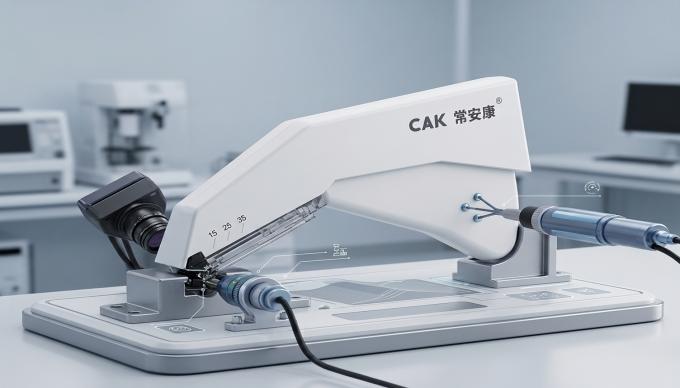
A medical skin stapler requires mechanical verification because its performance depends on controlled staple deployment and consistent staple formation.
Mechanical testing usually focuses on whether the device operates smoothly and whether the formed staples match the intended design. Important evaluation areas include firing performance, handle movement, staple consistency, and overall mechanical reliability.
The purpose of these tests is not simply to confirm that the device can release staples, but to verify that the device performs consistently throughout its intended use.
Testing methods should be based on the device structure, intended application, and applicable regulatory requirements. Different products may require different verification approaches depending on their design characteristics.
For medical buyers, this highlights why product selection should consider both specifications and manufacturing quality. A device with clear technical parameters still requires reliable production control to ensure consistency between individual units.
A surgical linear stapler requires quality verification focused on staple-line performance. Since this type of device creates a straight staple line, manufacturers pay particular attention to factors that influence consistency and mechanical accuracy.
Common verification areas include:
Staple-line consistency
The device should maintain stable staple placement across the intended closure length.
Staple formation
Testing evaluates whether staples achieve the expected formed shape after deployment.
Firing performance
The mechanical system is checked to ensure smooth and consistent operation.
Alignment accuracy
Proper alignment between components helps support reliable staple placement.
For example, CAK Medical linear stapler products include different staple-line lengths such as 44 mm, 60 mm, and 92 mm, with staple height options of 3.8 mm and 4.5 mm. These different configurations demonstrate why dimensional verification is an important part of quality control.
The purpose of testing is not only to confirm product specifications but also to ensure that different configurations maintain consistent manufacturing performance.
The quality requirements related to circular stapler use focus on maintaining accurate circular staple formation and reliable mechanical operation.
Because circular staplers create a circular staple pattern, manufacturers need to verify that different components work together precisely. Important quality considerations include the consistency of the staple ring, cartridge accuracy, firing mechanism performance, and overall device integrity.
Unlike linear closure systems, circular staplers depend heavily on diameter accuracy because different sizes are designed for different anatomical requirements.
CAK Medical circular stapler products include diameter options from 21 mm to 33 mm, including 21 mm, 23 mm, 26 mm, 29 mm, 31 mm, and 33 mm configurations. Maintaining consistent production quality across different sizes requires strict dimensional control and mechanical testing.
For medical device manufacturers, reliable circular stapler performance depends on controlling both individual components and the complete assembled system. This is also why experienced skin stapler manufacturers need comprehensive quality systems that cover different surgical stapler categories, rather than focusing only on individual product inspection.
Quality control continues after mechanical testing. For sterile surgical devices, packaging integrity, sterilization processes, and traceability are also important parts of product verification.
Sterility validation helps confirm that products supplied as sterile devices maintain their required condition before use. Packaging plays an equally important role because it protects the device and maintains the sterile barrier during storage and transportation.
Traceability systems allow manufacturers and healthcare organizations to track important product information throughout the supply chain. This commonly includes:
Lot numbers and batch information
Manufacturing records
Product identification details
Labeling information
A complete quality system connects manufacturing records, testing results, and product documentation together. This allows manufacturers to better manage product consistency and provides healthcare organizations with clearer product information.
A surgical stapler becomes ready for clinical use through a complete quality process that covers design, materials, dimensions, mechanical performance, sterility, packaging, and traceability.
Whether evaluating a medical skin stapler, surgical linear stapler, or products related to circular stapler use, quality verification is essential to ensure consistent device performance.
As a surgical stapler manufacturer, CAK Medical applies quality-control processes across its surgical stapler portfolio, including linear staplers, circular staplers, and skin staplers, supporting reliable solutions for different medical applications.
Hospitals can check product labeling, packaging information, and manufacturer documentation to confirm whether a surgical stapler is supplied as a sterile medical device.
Packaging information may include product identification, lot number, sterilization information, expiration details, and manufacturer details.
Lot numbers provide traceability by connecting individual products with specific manufacturing batches and quality records.
Yes. Packaging integrity and sterile barrier performance can be evaluated through appropriate validation and testing processes.
No. Different devices require different evaluations. Linear staplers, circular staplers, and skin staplers have different mechanical structures and performance requirements.
Shelf-life evaluation confirms that the device and packaging can maintain acceptable performance and integrity throughout the specified storage period.


 English
 français
 Español
 русский
 Deutsch
 italiano
 português
 العربية
 tiếng việt
 Türkçe

